Places of Interest
- Please use the links below to explore the area and find out more about the region or view the Gallery.
| The Pont d'Arc | Annonay |
| Vallon-Pont-d'Arc | Millau Sky Bridge |
| Privas | Avignon |
| Vogue | Grottes (caves) |
| Labeaume | Chauvet Cave |
| Balazuc |
The Pont d'Arc
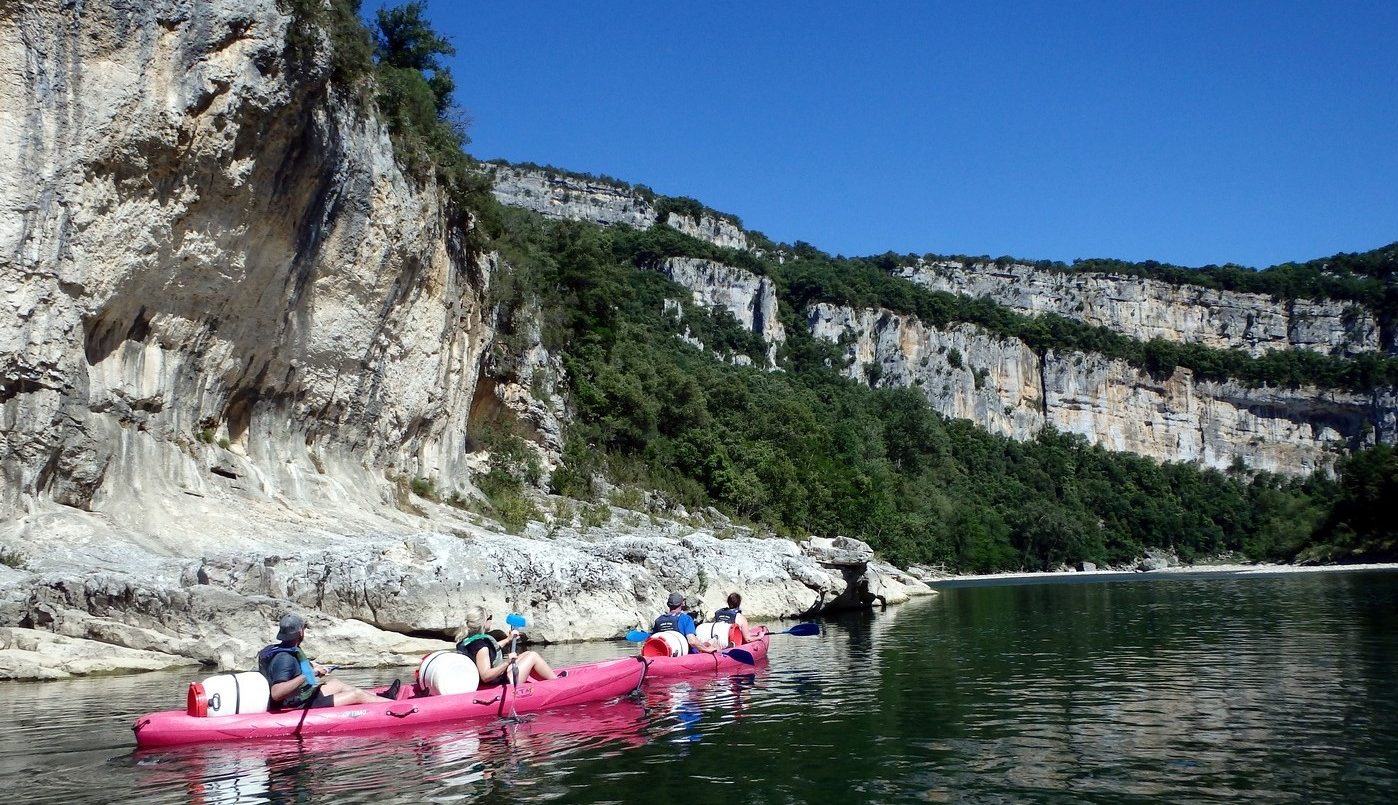
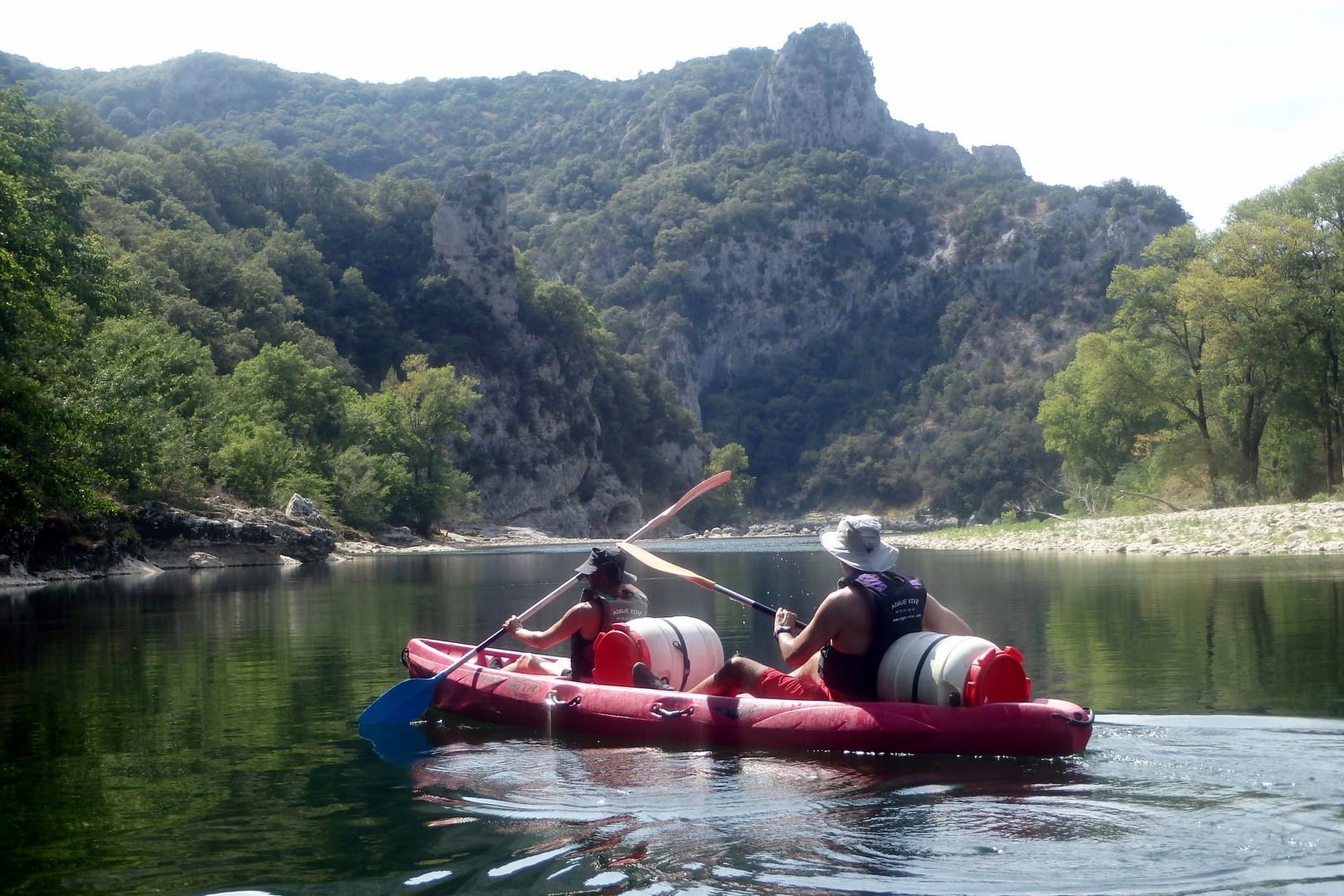
This elegant and majestic arch has been created in the limestone rock over thousands of years and has become the emblem of the entire region. This famous landmark is the largest natural arch in Europe and stands an impressive 66m high
(215ft) and has a span of 34m (110ft). Before the river managed to
break its way through, the Ardèche ran around the side along the Coombe
d'Arc where the road now is. It is along this Coombe ,half way up the cliff face, that the Chauvet cave was discovered in 1994.
Since the Ardèche was often a difficult river to ford, the bridge was a strategic route over which the Protestants and Catholics
fought. After a battle, the victors would often invite their enemies to
jump into the river, and pushed them if they seemed too hesitant. Since
Louis 13th destroyed the cornice, it has become too dangerous to cross.
Higher up on the left hand side (as pictured) is the prominant rock of Charlemagne by which a family of Bonelli Eagles nest. This is visible from the Hotel Belvedere and offers you a great opportunity to see these protected birds. The rock is named after the Great King because it resembles a famous image of King Charlemagne on horseback. Because of this the rapid which precedes the mighty Pont d'Arc is known as 'Charlemagne'.
Vallon-Pont-d'Arc
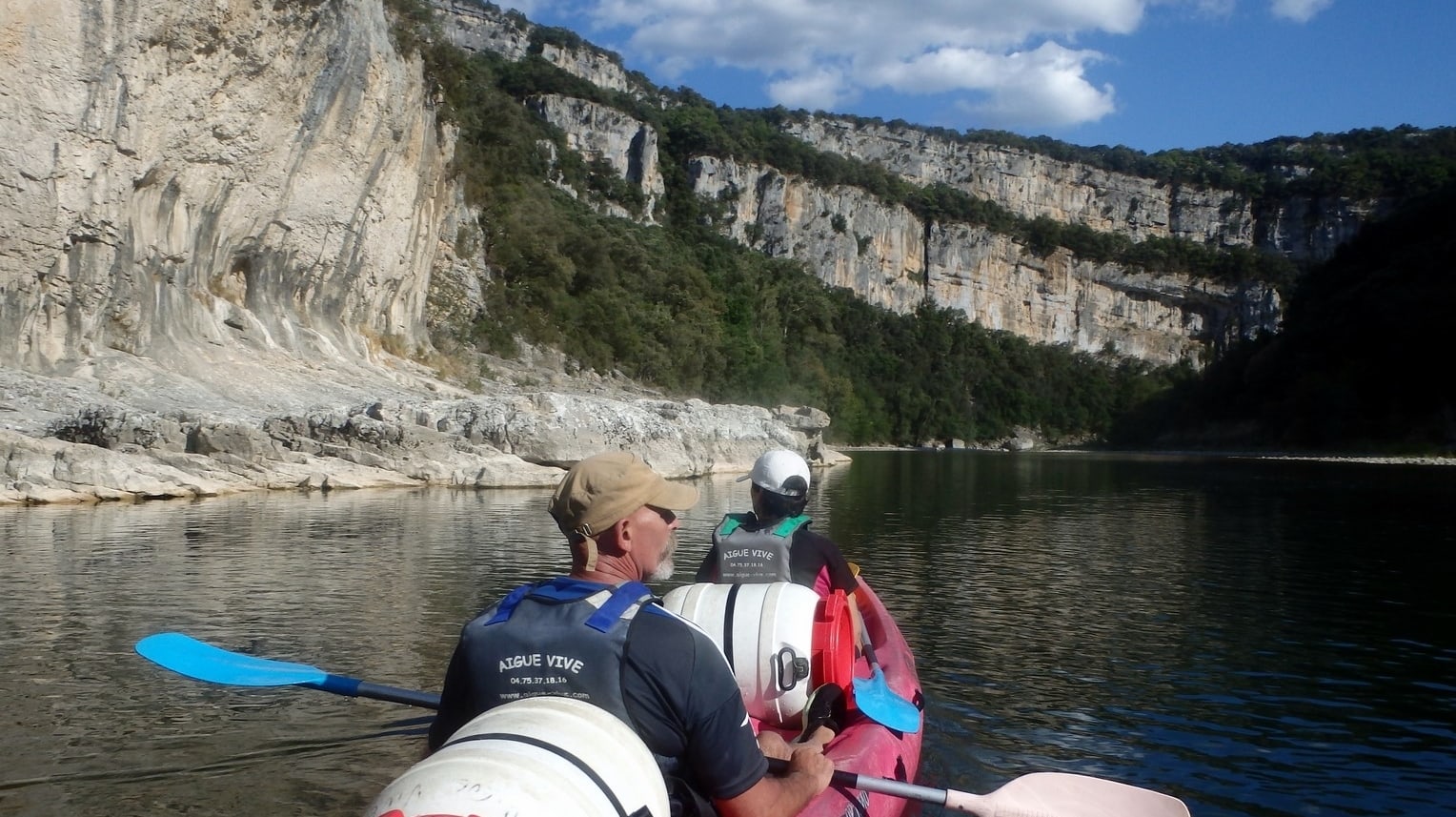
This small farming town becomes a splendid tourist resort in the spring. Sat on the edge of the Gorge of the Ardeche, Vallon enjoys a mild Mediterranean climate. With water, sun and nature all around, Vallon Pont d'Arc is the perfect centre for many outdoor activities. It is also steeped in history and surrounded by the most beautiful landscape.
This area has been inhabited throughout the centuries but only recently has it been realised for how long. In 1997, next to the Pont d'Arc, the Chauvet Cave was discovered containing Cave art between 30,000-32,0000 years old. This is the oldest discovery made to date and shows that man has existed in this corner of the world since the beginning.
Vallon Pont d'Arc became a Protestant stronghold during the religious wars and in 1621 the town was placed under siege. In 1628, King Louis XIIIth ordered that the Castle and the fortifications were destroyed and a new Catholic Lord was appointed. In 1629, the King gave this new Lord of Vallon the possessions of his subjects as compensation for the destruction of his castle. However, in order to get their possessions back, the inhabitants of Vallon built the new Castle of their Lord not where requested but instead built it in the centre of the village itself. In 1846 the castle was sold to the townsfolk and was converted into the townhall. It still contains the tapestries of Aubusson which are listed as a historical monument, illustrating the crusades, and they can be seen during the Town Hall's opening hours. These tapestries were a wedding gift to Lady Charlotte of Montreal (wife of a Vallon Lord) and depict the deeds of the first Crusaders in the Holy land under the leadership of Lord Godefroi de Bouillon.
Privas
The Ardèche region strongly embraced Protestants during the 16th century. A thriving silk industry grew here in Privas thanks to the planting of
mulberry trees, and the prosperity this brought led to the inhabitants
developing a certain freedom of thought. The area became a stronghold
of Protestant Huguenots.
During the religious wars of the 16th and 17th century, the people of the Ardèche resisted the persecution by the Catholic majority and suffered from the religious zeal of the times. Under the instructions of the religious zealot Cardinal Richelieu, the town of Privas was pillaged and burned to the ground in 1629. About one-fifth of the population emigrated. Privas, the administative capital of the Ardèche, has been largely rebuilt but there are still some ancient buildings which survived the siege. The Musee de la Terre Ardechoise and the Musee du Viverais enable visitors to relive the history of the Huguenot resistance.
Vogue
The lords of Vogüé! This family was undoubtedly the most powerful in the Vivarais. They were one of the greatest families in the Languedoc, if not in the entire kingdom. They were honoured with the title of Baron of the Languedoc and Governor of Provence. The revolution did not destroy them although they did lose some property and farmland. They succeeded in gradually buying back all the homes and properties anchored in the family history.
In the nineteenth century, they included two members of the French Academy: Charles-Jean Melchior, archaeologist and diplomat and Eugène Melchior who introduced the great Russian authors to the French intelligentsia. This medieval village is built like an amphitheatre in the curve of the cliff and is dominated by the 16th Century castle which replaced the earlier 12th century primitive fortress. It can be reached by a beautiful avenue of Chestnut trees planted in 1735.
Henri Charrière, probably better known by his nickname Papillon, was born November 16, 1906 in Saint-Etienne-de-Lugdarès in the Ardèche, he is buried a few kilometres south of Vogue in Lanas where his mother was a school mistress.
Labeaume
The limestone plateau is deserted today, but was very busy when the
silk worm industry was at its height.
The main centre in the area, Labeaume is a small village on the bank of the river of the some name, surrounded by cliffs and rocks like majestic, twisted and ruined walls. It is extremely attractive and has been given the "Picturesque Village" classification. The church and town hall are surrounded by old houses.The main square, Place du Sablas, on the edge of the river with its clear, rushing water, offers tourists beguiled by this incredible site the welcoming shade of centuries old plane trees.
The Labeaume Music Festival draws yet more visitors to these fascinating places with a programme of superb classical music. Every year a musical festival is held here, one of the most remarkable events in Southern Ardèche. In July and August, Labeaume becomes a village completely dedicated to classical music. Famous and talented artists meet in the evening in the church, the gorges, the bridge or the disused quarries. Nature becomes a grandiose concert hall creating a friendly and inimitable atmosphere.
Balazuc
Although officially classified as a medieval village, not everything in Balazuc dates from before the 16th Century. Although the ochre of its facades standing out against the green of wild fig trees, the cobbled slopes, vaulted passageways and narrowing streets has often encouraged comparisons with a Moorish village, this is just a coincidence.
A colony of Saracens led by Emir Youssouf was established in Balazuc in 730 after the Battle of Poitiers but on the other side of the river. In the same way, the famous "Saracen windows" mentioned in some brochures (the three-lobed windows that decorate certain houses), are not connected to the Saracens. There is, however, a 16th Century Chateau and a10th Century Keep with no door on ground level. Prison or for defense? The mystery remains. At the bottom of this village there is a Romanesque church with a three arched bell tower which can be reached from the outside. The apse is heightened to form a defensive tower since Balazuc was an isolated Catholic outpost in a predominantly Protestant lower Ardèche.
Annonay
Annonay was the home of the Montgolfier brothers. Joseph and Jacques-Etienne Montgolfier were the sons of a paper-maker in Annonay. They ascended the first hot-air balloon on 4th June 1783. The paper-making firm continues to this day, and on the first weekend in June each year they hold a "hot-air balloon championship" to celebrate the event. About 30 or so balloons also offer first flights to the public for about €150. There is also an obelisk at Annonay in honour of the Montgolfier brothers.
In 1777, Joseph observed laundry drying over a fire which incidentally formed pockets that billowed upwards. Joseph made his first definitive experiments in November of 1782 while living in Avignon. He reported, some years later, that he was watching a fire one evening while contemplating one of the great military issues of the day - an assault on the fortress of Gibraltar, which had proved impregnable by both sea and land.
Joseph mused on the possibility of an air assault using troops lifted by the same force that was lifting the embers from the fire. He believed that contained within the smoke was a special gas, called 'Montgolfier Gas', with a special property he called 'levity'. Joseph then recruited his brother to balloon building by writing the prophetic words: "Get in a supply of taffeta and of cordage, quickly, and you will see one of the most astonishing sights in the world." On 19 September 1783 the Aerostat Réveillon (as Etienne referred to it) was flown with the first living beings in a basket attached to the balloon: a sheep, called Montauciel (Climb-to-the-sky), a duck and a rooster. This demonstration was performed before a huge crowd at the Royal Palace in Versailles, before King Louis XVI of France and Queen Marie Antoinette. The flight lasted approximately 8 minutes, covered 2 miles, and obtained an altitude of about 1500 feet. The animals survived the trip unharmed. ...the sheep was discovered nibbling imperturbably on straw while the cock and the duck cowered in a corner.
Annonay was also the birthplace of Marc Séguin, inventor and engineer, who developed the first suspension bridge in continental Europe in 1825, building and administering toll-bridges for a total of 186 bridges throughout France. He also invented the tubular steam-engine boiler in 1827,which enabled steam-engine trains to increase power and velocity from 4 miles per hour to 25 miles per hour making railroad a more viable mode of transportation. Later, he would collaborate with George Stephenson to help him win the speed contest at Rainhill Trials, where Stephenson's Rocket won using the fire-tube boiler. Marc Séguin was voted into the Académie des Sciences in 1845, received the Légion d'honneur in 1836 and wrote numerous books on the use of physics and mathematics in building bridges and locomotives engines.
Millau Sky Bridge
This marvel of modern engineering was opened on the 16th Dec 2004. It is the highest road bridge in the world and was designed by British architect Norman Foster.
Less than 2 hours from Vallon-Pont-d'Arc, the bridge spans the River Tarn and was made by the same company who built the Eiffel tower. It stands at an impressive 343m (1,125ft) which is higher than the Eiffel Tower and only a mere 125ft shorter than the Empire State building!
The feeling of driving over the clouds is truly one to remember!
Avignon
This walled city is one of remarkable history. It is famous for its Palais des Papes(Palace of the Popes) which is one of the largest and important medieval Gothic buildings in Europe. Seven Popes (all French) lived there during much of the 14th Century when it became the seat of the Papacy instead of Rome. The majority of the Palace is open to the public now, and houses a museum.
A famous theater festival is held annually in Avignon. Founded in 1947, the Avignon Festival comprises both traditional theatrical events and other art forms such as dance, music and cinema, making good use of the town's historical monuments. Taking place every summer betweem 10th July and 5th August, it welcomes approximately 100,000+ visitors. There are really two festivals that take place: the more formal "Festival In", which presents plays inside the Palace of the Popes and the more bohemian "Festival Off", which is known for its presentation of largely undiscovered plays and street performances.
Avingnon is also well known for the Saint Bénézet bridge which is better know as "le pont d'Avignon" from the song of the same name. The bridge spanned the Rhone and was initially built between 1171 and 1185,
with an original length of some 900m (2950 ft), but it suffered
frequent collapses during floods and had to be reconstructed several
times. Several arches were already missing (and spanned by wooden
sections) before the remainder was damaged beyond repair in 1668 by a catastophic flood. Today only four of the initial 22 arches remain and on one of them stands the small Romanesque chapel of Saint-Bénézet.
In 1995 UNESCO included Avignon as a World Heritage Site due to "an exceptional group of monuments that testify to the leading role played by Avignon in 14th-century Christian Europe."
Avignon belonged to the Papacy until 1791 when it was reincorporated into France during the French Revolution.
Grottes (Caves)
The name Ardèche is reputed to originate from the latin "Ardesco" meaning "I burn" which refered to the fact that before water a river of lava once flowed here.
The fiery temperament of the Ardèche comes out even in its landscapes. The Coiron plateau and its black cliffs are made of basalt, while the Ardèche mountains are a land of strange domes of solidified lava known as sucs. These volcanically-created summits are, on a geological scale, still very young - they were formed a mere 7 or 8 million years ago. They are made of a substance called clinkstone - a product of the cooling lava which produces a ringing sound underfoot. Within the Ardèche Gorge, black basalt stones are strewn along the banks and are a constant reminder of the volcanic history of the area.
As you move further up the Ardèche River, you can marvel at the awe-inspiring sight of the Ray-pic waterfall which cascades 60m over a wall of basaltic
lava flow which created gorges that look like church organs; mineral deposits in astonishing shapes; vast caverns and narrow subterranean passageways.
A total of seven caves and potholes are open to visitors. The Orgnac pothole, listed as a major natural attraction, is one of the largest in Europe - its specially fitted out halls with 150-foot ceilings extend over three hectares and make a unique underground environment. Other sub-surface attractions include the Marzal pothole with its prehistoric zoo and museum devoted to the world underground, the Forestière pothole and its fascinating cave zoo, and caves at La Madeleine, Saint-Marcel d'Ardèche, Les Huguenots and Les Tunnels. All of which are local to Vallon-Pont-d'Arc and the Gorges.
Did you know? The entrance to a pothole is vertical - but the entrance to a cave is horizontal.